
The cure for your thinking addiction
A guide for unhooking from the voice in your head and stepping into a larger life


On Thursday evening, your boss texts you. “Can you come into the office tomorrow for a bit, 9:30am?” You do your best to respond casually.
“Of course, see you then.”
Inside, you are not casual. Your stomach has turned liquid. Why does she want you in on Friday, your WFH day? Your standing 1:1s are on Tuesdays.
You start gaming out scenarios, and they all end the same—termination. There could be no other reason. Makes sense, do it before the weekend… Should have sent that deliverable earlier, shouldn’t have taken that last PTO… should, shouldn’t, rinse and repeat.
You barely sleep. Your melatonin mocks you. By 3am, you’ve given up and you’re on LinkedIn, drafting responses to recruiters from a year ago.
Finally, blessedly—cursedly—you sit across your boss’s desk, doing your damnedest to be like that one situationship who always let you down: studied nonchalance.
“So,” she closes her laptop.
Here it comes.
“Paul resigned. Definitely not alcoholism.” Did she just wink? “He was about to be promoted to director.”
You nod. You can feel your pulse in your neck.
“Now, we think it should be you. I made the case with leadership, they agreed. Are you up for it?”
“Yes—yeah, absolutely… Thank you.”
The rest of the meeting passes in a blur. You walk out grinning. You reach the elevator. The doors open, close. You suddenly feel silly.
Why did I lose a night of sleep over this? Why did I scroll LinkedIn like a banshee on blow? What the hell is wrong with me?
And then the doozy: Wait. Director? That’s a totally different job. I’m already a stress case. They’re gonna realize I’m out of my depth. How could they not?
The spiraling thoughts follow you, and by the time you’re on the train home, you’re cursing your promotion.
And on and on it goes…
***
The fucked up part is that this passes as completely normal. If you’ve been alive in a body in modern society over the last decade, you’ve almost certainly been there. You probably vented about it to friends over lunch and moved on, not realizing the boss text just turned up the volume on what’s already the default state of being for you, and nearly everyone else: a state of relentless, compulsive thinking.
It hurts more than we allow ourselves to notice. I believe it’s the subtlest addiction of them all.
A couple months ago, I published an essay distilling my core thesis on this: addiction has become an organizing force of modern life, and if you follow it all the way down, past the substances and the screens, you arrive here: at thinking itself.
Much to my surprise, it went viral—read by over 90,000 people, hundreds of whom wrote to me about migraine relief, OCD softening, even long-time meditators reporting breakthroughs. I suspect it resonated in part because more of us, watching the world seemingly unravel, are finally ready to see the pattern in ourselves.
I also had some standing to make the claim. I’m a survivor of a multi-substance addiction that nearly killed me, and crawling out of it, I found that the narcotic chemicals, and later the phone, were never the final boss.
Thinking was the final boss.
When I got sober, I was confronted with what I’d been medicating: a crushing, ambient anxiety. I’d built a career on public speaking, only to find I couldn’t get through a team meeting without a mild panic attack. The voice in my head was merciless. I appraised myself in every room, judged everyone else in it, micro-adjusted my personality to seem bigger than I was, and hyper-analyzed every way I was failing to live up to my potential. And the whole time, I was waiting for people to realize I was a fraud.
It took years, and more practice across more traditions and modalities than I’ll bore you with here, to learn how to unhook from my thoughts. But now—and I promise I’m aware of how all of this will sound—overthinking still happens, it just releases on its own. I’m no longer a prisoner to the voice in my head, which means I no longer need to formally meditate to feel present. An ordinary moment, like re-writing this paragraph on a loud, cross-country flight, goes deeper than the best sits did from my decade of try-hard meditation.
More of my waking hours pass in something like a tuned-in flow state, what athletes call the zone. I’ve learned to trust spontaneity, so I don’t have to rehearse what I’m going to say. What comes out is better, like it’s arriving from somewhere much more creative and intelligent than the little me. I can wait for inspiration instead of grinding for it, although I’m more forgetful than I used to be, which feels like a fair trade. And it’s left me with a higher baseline of wellbeing than I thought was possible, especially for a formerly neurotic guy like me.
In the years since this shift, I’ve worked with all kinds of people on it—in one-on-one somatic sessions, addiction programs, men’s groups, and with founders who can build nine-figure companies yet struggle to rest their minds for five minutes on vacation. Whatever the presenting problem, the engine is always the same.
Overthinking is the signature state of the modern mind.
We’ve become a left-hemisphere culture, each of us under more cognitive load than any humans throughout all of history, drowning in information, endless choices, faux connection, and an attention economy literally (literally!) designed to distract us.
But it isn’t only modernity. Our minds evolved as threat-detection machines. We are descendants of apes, middle-of-the-food-chain creatures who had to scan the savanna for predators, track who in the tribe was friend and foe, and plan the day’s hunt. That physically and socially oriented software kept us alive. But now most of us live in conditions of relative comfort, ironically barraged with a digital onslaught of synthetic threats that the mind reads as predators all the same. And, to be fair, some of them are.
The problem is that most of us, monks aside, were never given the training to update our software. So the mind never stops scanning for threats or something to fix. The result is the daily, whirring thought-tornadoes most of us have come to mistake for our selves.
Can’t stay present when the people you love are right in front of you? You’re just spacey, always have been. Lying awake after googling a symptom and landing on the worst possible diagnosis? You’re just a worrier, like your grandmother. Leaving a party and auditing every conversation on the drive home until it calcifies into proof you’re unlovable? You’re just self-aware. Highly sensitive.
Freedom from the voice in your head is a trainable skill.
What if you could change your relationship with your mind so it became a wonderfully useful tool you can pick up and set down? What if, when your boss texts you on Thursday night, you could notice a completely normal pulse of fear without being defined by it, and then the spiral that follows just… doesn’t? And when the good news comes the next day, you’d just be like, oh wow, sick.
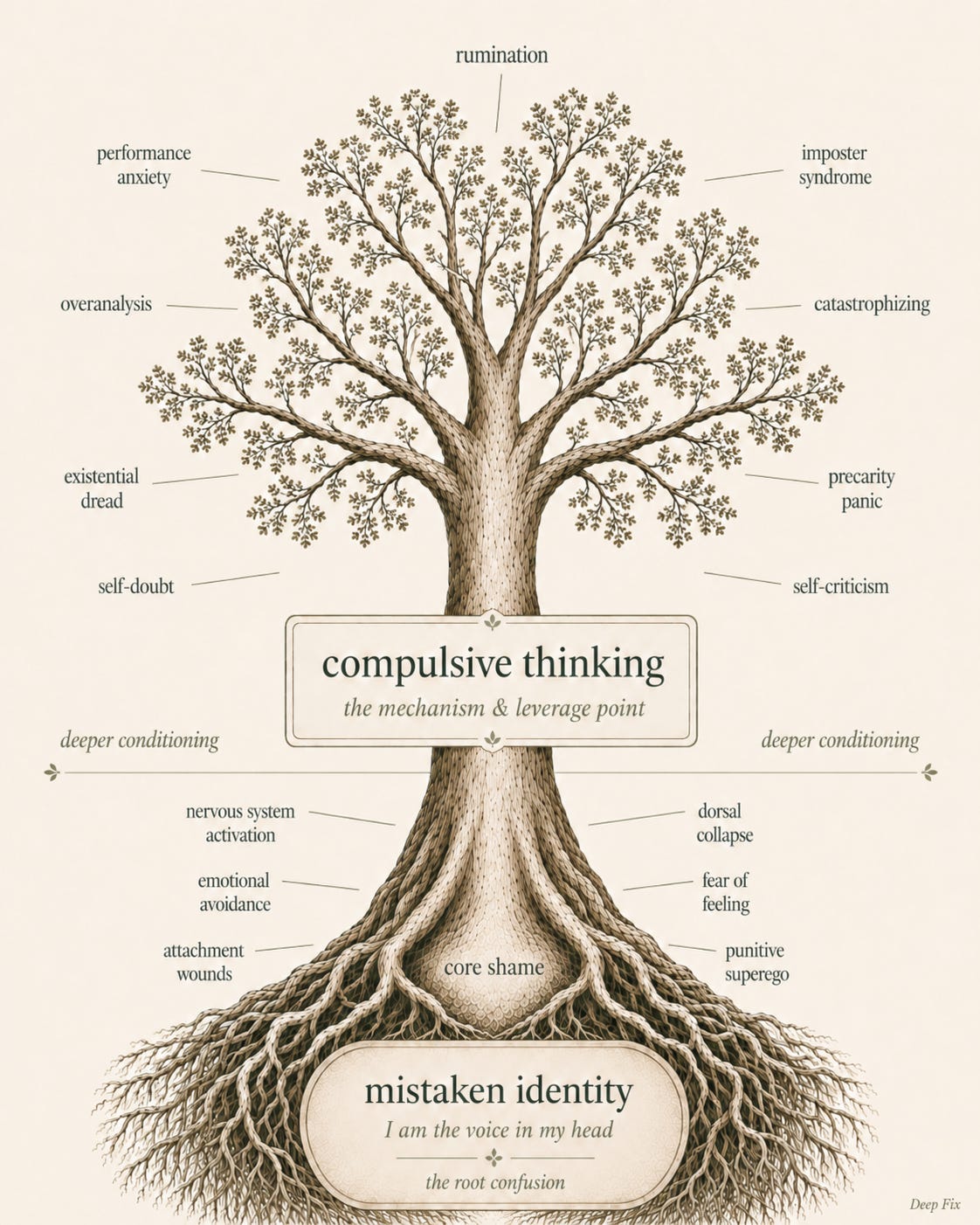
Look at our opening scene again, a person called into the office by their boss. Run it through a strictly psychological lens, and you’ll find performance anxiety, rumination, imposter syndrome, early-attachment stuff, dorsal collapse alternating with sympathetic mobilization, a punitive superego in full song, late-capitalist precarity panic, existential dread—and that’s just the surface. You could spend years in therapy on any one of them.
But what if all of those are downstream from one root cause? What if you don’t have to untangle each strand—you could just pull the whole thing out at the root?
This is the promise that spiritual traditions offer. Compulsive thinking is the mechanism, and what it feeds is something even more fundamental: a case of mistaken identity, the lifelong assumption that the thoughts appearing in your head are you. Truly seeing this, not just understanding it intellectually, produces the kind of experience that makes people want to scream from the rooftops, or, in better hands, write Zen poetry. And frankly, the relief this offers is still undersold.
Spiritual traditions correctly point to what becomes available when you loosen the grip on the thinking mind and rest in something vaster. The trouble is they were built for a life almost none of us live: full immersion, ethical containers, community, devotion to the sacred as the orienting axis. Strip that away, sell it as McMindfulness or distill it to “just see through the false self,” and you fall into intellectualization and spiritual bypassing—the look of insight on a nervous system that never changed.
Modern psychological practice often works the symptoms—reframe your catastrophic thoughts, medicate your anxiety, do some box breathing—and it can genuinely help, for a time. But it has the opposite problem, skipping the root cause entirely. You can do CBT for years and still end up at 3 a.m. drafting LinkedIn responses to recruiters.
You need tools made for someone with a smartphone and seven unmuted group chats.
Which is to say, you need practical, contemplative tools designed to change your relationship with overthinking.
This begins with healing a body running on chronic activation. Annoyingly, overthinking almost always protects you from feeling something uncomfortable, kind of like how a fever fights off an infection. Take the protagonist of our opening scene. He was thinking his way through his problem rather than simply allowing himself to feel the stress, fear, shame, and helplessness it produced in his body.
A nervous system held in low-grade threat has no real shot at transcendence, which is why somatic psychology is non-negotiable: to settle the body into enough safety that the mind can let go of its watch.
And, perhaps most overlooked in this conversation, is the wisdom of addiction recovery. If we are all subject to addiction today—and recognizing this, fittingly, is the first step—you stand to benefit from the principles of recovery: the willingness to face the problem squarely, the radical ownership of your part in it, and the move toward action and service before you feel “fully healed.” Especially in the AI age, when the temptation to outsource every difficulty grows by the month.
What follows is a guide for freeing yourself from compulsive thinking that weaves what I’ve found most helpful from addiction recovery, somatic psychology, and contemplative practice.
It’s presented roughly in that order, with each section building on the previous one, opening toward an awareness much larger than thought.
Dr. Anna Lembke’s research on dopamine and addiction suggests it takes about four weeks to reset the brain’s reward pathways—and meditation research finds neural changes on a similar timeline. So give these practices a month of honest effort, and you should, mercifully, feel the difference. And if you don’t, I’d genuinely like to know.
The cure for your thinking addiction: a guide
The unsexy part (aka the truth)
The majority of people, when they first hear my addicted-to-thinking frame, say something like oh my god, that’s *so* me—and then go right on doing what they were doing. The thinking mind that has been running the show for thirty or seventy years is not interested in being deposed by a clever Substack. It will absorb it, file it under interesting things I’ve read… and continue.
For this to work, you have to be willing to admit you have a thinking problem. To say, “compulsive thinking runs my life, it hurts me, and I will no longer pretend it doesn’t.” Which won’t be too hard for most folks to say, because overthinking is the most relatable thing in the world. That, and the small horror of replying ‘you too!’ to a waiter who just said ‘enjoy your meal.’
So the admission has to land somewhere lower, and deeper, than the head. You have to viscerally feel it, to the point where something in you says: yes, this is real, and I want out.
Ask yourself: Do I actually want to be free of this, or do I just want to keep reading about being free of this? And most operatively, am I willing to work on it?
Count the cost
Addiction is a two-headed devil, made of compulsivity and consequences: the behavior you can’t seem to stop, and what that behavior costs you. And because the compulsive part runs unconsciously, the way in is through the other head—you have to look closely at the negative consequences in your life.
If you agreed in the last section that you’re willing to work on this, reflect honestly. And if you can, write about it. What has compulsive thinking cost you? Sleep, for one. Dinners without tasting the food. Loved ones who felt your absence when you were sitting right in front of them. That thing you wanted to do or build or say that your inner committee of overthinkers shot down before you even gave yourself a chance.
I might even be so bold as to suggest that compulsive thinking has been the root of all your problems in life. Well—maybe not all your problems. The grocery store indeed ran out of your favorite oat milk. Tariffs, apparently. But the ten-minute internal monologue you ran about it? That part was you, and it was optional.1 And if you can feel the truth of that, even partially, radical change becomes possible.
Cut the inputs
Just like it is impossibly difficult to get sober if you hang out at a bar all day, you have virtually no chance of entering a new relationship with thinking if you are, as the kids say, extremely online. Screens are the ultimate pacifier, and most of us are sucking on one for five or more hours a day.
The most recent numbers put the average American at around 205 phone pickups per day—basically once every five minutes you’re awake—and for millennials it’s closer to 324. Eighty percent of us check the phone within ten minutes of waking up.
We are not the same animal we were two decades ago, and we will spend the rest of our lives—and our children’s lives—reckoning with what the smartphone era is costing us as embodied beings.
Most of us know all of this already, yet we are still massively underreacting. Reaching for the phone has become a reflex, like flinching from a hot stove. Neurons that fire together wire together, so every rep lays the groove a little deeper, until reaching becomes the path of least resistance and not-feeling becomes your default. As long as the phone is in your hand at every uncomfortable moment, the capacity to unhook from thought and find the more wondrous part of you never gets a chance to grow.
More sinisterly, the phone also creates more of the discomfort it then relieves. Maybe you open it to numb a dull moment, but ten minutes later, you put the phone down in disgust. This is the oldest move in the dealer’s playbook: get ’em dope sick, then sell ’em the cure.
You must reduce your digital inputs to heal your brain and start feeling your life. I mean it. Below are the practices that worked for me, treating the phone the way you’d treat any addictive substance.
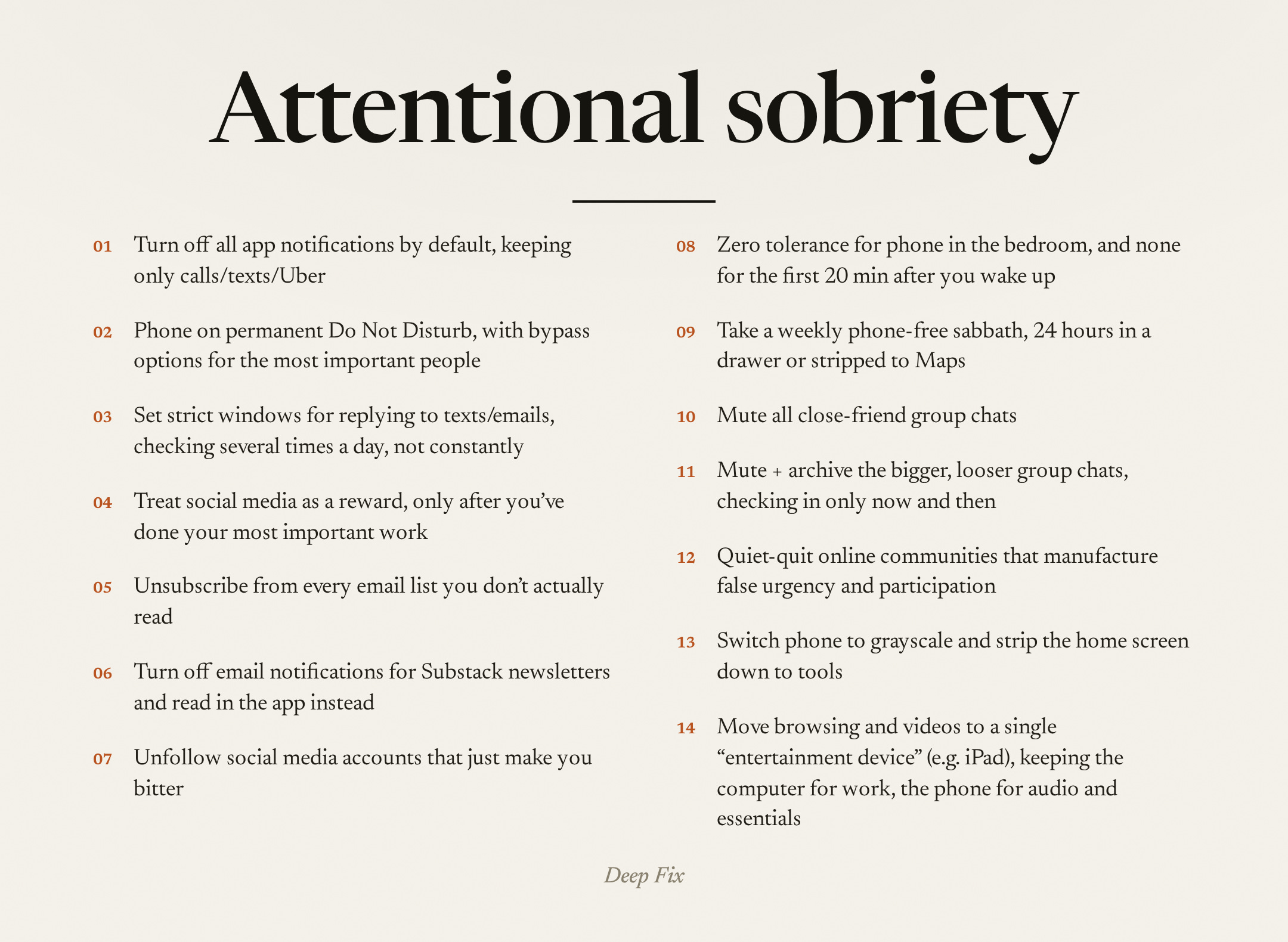
Humor me for just one month, and everything you’re muting will be exactly as unhinged when you return.
As the body stops bracing for the next hit, the mind will follow.
Get clear on what you want
Before you write this off as all too dreary a business, let me remind you why we are doing this.
In my most recent essay, I described how easily most of us can list the things we don’t want in life, and how much harder it is to define what we do. Desiring to stop overthinking is solidly in the “don’t-want” column. Which is fine, but it’s not a clear direction to move in. Change goes faster—and easier—when you have something to walk towards, whether that’s love, truth, aliveness, connection, awakening, whatever calls you.
Recovery dubs this The Promises: keep doing the work, live with integrity, and your life will get better than you can imagine, on life’s terms.2 The spiritual traditions promise even more on the other side of awakening. That is, on the other side of the small self, something vast, something free, something loving and beautiful.
To get a taste of this, pay close attention to what comes up for you as you reflect on one of my favorite psychoactive prompts:
If you had infinite money, no fear, and didn’t need recognition, what would you do? What would you create?
Take a few minutes to write down some ideas.
Spot the difference between a thought and a thinking spiral
If you allowed yourself a moment with the prompt above, you probably noticed two things happen in close succession. First, a thought arrived—a word, phrase, idea, or image, something that just poofed into being, unbidden. And then, almost immediately, a string of thoughts about that first thought arose. These are often quick to analyze and quicker to doubt. They love to bully and dismiss. Well, that’s not realistic… I don’t have the time… I don’t have the money… What if, what if… I fail.
The point of all this is not to go to war with your mind or make analytical thinking the enemy (you’d lose; you’ve already lost the moment you start fighting). But learning to tell these two apart—thoughts v. compulsive thinking—becomes one of the most crucial skills available to you.3
Compulsive thinking is thoughts about thoughts, running in an unaware loop: ruminating on the past, fantasizing about the future, rehashing arguments, catastrophizing, prosecuting yourself for old wounds, etc. It’s the ego at work, contracting you into a small sense of self and bracing against something uncomfortable in the body.
Thoughts arise and pass on their own. They are not you. They are organic bursts of literal energy. They can be of anything: arbitrary image, dark impulse, poignant memory, liberating truth. But when you’re quiet and listening—and lucky—they arrive from Source as inspiration, creativity, insight, and truth.
It’s the difference between the effortless wisdom of epiphany and the drudgery of cogitation.
From here on out, start paying close attention to the thoughts that arrive on their own, especially the ones that energize you, that feel like inspiration, like primal intelligence moving through you.
Catching yourself is the goal, and you need to celebrate it
You’ll also notice, far more often, the other kind: the moment you realize you’ve been lost in a thinking spiral for the last three minutes… or three hours.
Oftentimes this realization comes with a flash of disgust. And then even more self-critical thoughts about why you got lost thinking, yet again. But the nature of compulsive thinking is that it’s unconscious—it happens outside of your conscious control. When it comes to attention, there are really only two modes: unaware and aware. Just like the exact moment you fall asleep is out of your control, slipping into a thought spiral is too. And so is the moment you “wake up” from it.
So what you’re going to start doing is celebrating each time you catch yourself. I cannot stress enough how important this is: when it comes to lasting habit change, most people too readily bypass their reward mechanism—and the reward is what truly drives the change. It’s also what keeps you going to the four-week mark, when habits finally start to stick.
Every time you catch yourself lost in a spiral: pause… then celebrate it! Put a literal smile on your face, your whole body. When the negative thought shows up—ugh, why did I get lost again—answer it with good job for catching it! Proverbially pat yourself on the back. Lean into the performative element, the fake-it-till-you-make-it of it. This celebration is what trains your system to notice more moments of being lost, priming you to be aware more often than unaware.
Relax your brain
You can make incredible progress simply by catching yourself lost in thought as you move through your day. And if you want to take this further, extend the pause. After you catch and celebrate, instead of snapping back to whatever you were doing, let the moment open and soften the body.
I’ve written before about dropping attention down to the soles of the feet. Releasing the unconscious ass-clench, if you’re anything like me.
But please do not forget the one place it would seem most obvious to relax: the head. Open and release the jaw, unfurrow the brow, soften the small muscles around the corners of your eyes, and let the scalp loosen. And then, one level deeper, relax the brain itself.4 Now, there are no muscles in your brain, but since most Westerners feel like thoughts arise somewhere in the head, overthinking has the distinct texture of mental tension, a contraction. The anatomy may be metaphorical, but the felt sense is absolutely real. And going after it works.
So when you catch yourself overthinking, relax all the muscles around your skull, then let that softening sink inward. Michael Taft, my favorite meditation teacher, has a prompt for this exactly: relax the core of your mind. It’s worth practicing throughout the day, too. The more you relax, the more you can open to feeling.
Let the animal in you finish feeling
What modern life has done, with its steady drip of alarms from screens, is constantly fire activation without offering a way to complete it. The body braces and stays braced. The mind, sensing the unfinished business, takes over and manufactures a story to make sense of the unease.5
But the core observation from Peter Levine and somatic psychotherapy is that the nervous system needs to complete the cycles of activation, response, discharge, and return to rest.
So you need to learn to reach into the body. Before the mind turns a sensation into a story, there’s a brief moment of pure felt tone, whether the experience is pleasant, unpleasant, or neutral. The early Buddhists called it vedanā, and the practice is to stay with the sensation in that moment, before craving or aversion grabs it and starts building a story around it.
This is the heart of what’s called somatic tracking: you notice something arising in the body, and instead of going up into the head to figure out what it means, you bring your attention directly toward it with curiosity.6 This is why I’ve reluctantly become the ‘where do you feel that in your body?’ guy, a question I used to find insufferable, yet which remains undefeated.
And curiosity is the active ingredient. Approaching a sensation with genuine interest rather than fear is how you signal to the nervous system that it’s safe, that there’s nothing here you need to flee, and that felt safety is what finally lets the braced activation discharge.
So you stay there—gently and lovingly—as long as you can. Notice where it’s located, near the skin or deeper in, its shape and size, whether it’s still or whether it’s moving. The one rule is no agenda: the moment curiously tracking the feeling in your body becomes a mechanism to banish that feeling, you’ve snuck aversion through the back door. The body reads it as one more attempt to flee.
Given attention without agenda, the body knows how to complete its own cycles and heals itself. The psyche works the same, once you stop interfering. You must let the animal finish feeling.
There’s nothing to do here
To help you get out of your own way, I’ll hand you to my favorite instruction from Loch Kelly, a meditation teacher: relax the problem-solver.
The thinking mind is a problem-solving organ. It often functions like a manager: the part of you whose job it is to anticipate, plan, control, and prevent the bad thing from happening. It is tremendously good at its job, which is why it got promoted. And like any overworked manager, it cannot remember a time when it was not on duty.
So you ask it, coaxingly, to take a break. Lovingly suggest it take its hands off the tiller for a little while. And then, with the manager relaxed even slightly, you sit with this question for five, ten, thirty minutes:
What is here, right here, right now, when there is no problem to solve?
Don’t strain for an answer (there isn’t one). The trick is to stay in a mode of open-ended receptivity rather than trying to get something right. Just notice what is present: your breath, your breathing, the sounds of the room, the weight of your body, the smell of the passing dust…
The manager will keep coming back to solve problems, and when it does, you let it. Then you relax again. You keep reminding your whole system that there is no problem to solve right now. There’s no tiger.
Whose voice is it?
The voice in your head sounds exactly like you, which is unfortunate, because if it sounded like anyone else, you would have stopped listening to it years ago. (Or maybe checked in at a psych ward.) Instead, because it sounds exactly like you, the assumption that it is you goes unexamined, sometimes for decades.
Catching that assumption and questioning it lies at the core of contemplative practice. Sit for a moment and listen for the next thought to arrive. When it comes—and it will, very soon, almost certainly in a familiar voice—notice that something in you registered it as a thought. Something received it. That receiver, or the awareness of it, was not the thought itself. The awareness was present before the thought arrived and will be present after it passes.
If you can hear the voice in your head, you must be some-thing other than the voice.7 What noticing this allows, over time, is for the voice to become something you hear without engaging. The voice does not have to be obeyed or defended, or even answered. It is mental chatter, arising in the field of awareness the way sounds arise in the field of hearing. It can be quite helpful to imagine your thoughts as a radio playing in a room of someone else’s house, nothing to do with you.8
Rest assured, the manager-self will not like this. The moment you start noticing the voice as just one stream among many, more voices will arrive to defend its authority. Am I doing this right? This feels weird? Who am I if I am not these thoughts? All of that is more chatter, made of the same stuff. You let it arrive, you notice it, and you keep recognizing.
What you realize, the more often you do this, is that identifying with the voice has been the central act of forgetting your larger self.
Zoom out
One of the most reliable ways to remember you are much bigger than your thoughts is to literally zoom out. Instead of focusing on anything in particular, you relax the sense of focus itself. Wherever you are, let attention soften and widen. Notice the entire visual field, miraculously appearing in front of you. The room, the furniture, the view out the windows… then notice sounds arriving on their own, without any effort from you.
Welcome all of it: sensations, sights, sounds, subtle energies you can’t describe, the vibratory nature of experience. When the mind contracts onto some singular point, relax again and let attention go wide. Never strain to open further, because you’re not actually opening anything; the vastness is already present, simply waiting to be noticed.
Now, from this soft and expanded attention, notice your thoughts. They are the tiniest sliver of what you’re experiencing, and arising and passing, no different than anything else that comes and goes.
One of the keys to unwinding overthinking is finding the other parts of your experience that are more interesting than your thoughts.
The zoomed-out view is full of excellent candidates, whether your sensate experience, a general felt sense of light or beauty, the physical space experience happens in, or the sheer miracle of any of it appearing. When you’re hooked, a thought feels like the whole of reality. Train your attention to zoom out and lose itself in whatever doorway beckons your curiosity.
Somewhere to rest that no thought can reach
Countless thoughts have already come and passed for you today. Where are they now? Try to find any one of the old ones and notice that they’re gone, which is what the Zen masters mean when they say thoughts leave no trace, like writing your name with your finger on the surface of a pond.
Now notice what remains untouched. Up to this point, we’ve explored it a few different ways: what’s present when you relax the problem-solver, the receiver behind the voice, the awareness you zoom out into. The simplest word, and my favorite for it, is Being. It’s the same presence that was there when you were a little child running at the playground, the same awareness that looks in the mirror and doesn’t feel any older, the one part of you that’s never been impacted by anything that’s ever happened to you, that cannot be improved and cannot be diminished.
Pause and relax into it now. Go underneath the thoughts, and get curious about the bare, unmistakable sense that you simply exist, this always-on awareness that never turns off. Sink into it the way a stone sinks to the bottom of a lake.
The yogic traditions I came up in have a Sanskrit word for this: sat-chit-ananda; being, consciousness, bliss. Meaning, it doesn’t just feel neutral to rest here. There’s a bliss to simply being, a fundamental okayness underneath everything, and learning to trust that reorganized my life. What helped me most was taking the mystics at their word: that this is the most ordinary thing in the world, and that we all have access to it, right now, wherever we are.
Become more interested in this than in the fluctuations of the thinking mind, and identity itself begins to shift, since Being is not separate from thinking. You could even say it gives rise to thinking, so any time you notice a thought, you can let it dissolve back into Being, the way it came.
Rest there as often as you like.
A larger life awaits
If you’ve stayed with me this far (bless your heart), the whole thing might feel like a lot. But it’s actually rather simple, so simple it can feel very fucking difficult. Like getting sober, the first days of detoxing your mind are the hardest, and you’ll likely feel withdrawal.
But the four-week window is real. Even the most deep-seated habits can transform in that period, and as you practice this, the change starts to build on itself. It becomes fun rather than work, and you find yourself finally swimming with the current.
On a practical level, there will be another Thursday night. A text will come again, whether from your boss, your ex, or, god forbid, your kid’s school. The difference is that the fear just moves through you now, and you trust yourself to meet the moment, with capacity to spare for our batshit world.
Gurdjieff said you cannot get out of a prison you don’t know you’re in. I spent most of my life in one without the faintest idea, mistaking my hyperanalytic mind for strength, sometimes even genius. As we move deeper into the AI age, I’ve come to believe that unhooking from thought, and growing the intuitive human capacities that live beneath it, is the most important skill any of us can develop. There’s also nothing that feels better than getting free of the compulsion.
And yet nearly all of us are still in the cell, narrating our way through the one life we get, so utterly convinced the voice is us that we never think to question it. The trippiest part, the part that took me a decade and nearly cost me my life to learn, is that the door was open the whole time.
I’d love to tell you I walked out in a blaze of enlightenment. I’ve had my breakthroughs, proper before-and-after shifts. But none of them are what freed me from overthinking. Mostly I just kept noticing the door, forgetting it was open, and noticing it again, for years. The secret is the noticing compounds.
And the result is like taking Advil for a headache; you don’t know exactly when, but at some point it’s just gone. One day you realize you’ve been free for a while without registering it, and the old story, the one that narrates nonstop about you being small and worthless, starts to feel like a melodramatic movie you walked out of. Only by walking out could I step into a life wilder and more beautiful than anything I’d have dared to plan. And you can walk out too.
Essays like this take me 40-50 hours of work. If you got something from it, consider becoming a paid subscriber. It’s the best way to directly support my work.
Or, if you want to contribute in a smaller way, a like or share helps a dude who does what I do.
What’s next: The workshops on this have gone well enough that I’m building a four-week course version. I’d love to hear what worked for you, what didn’t, and what you’d want in a deeper treatment. Leave a comment or reply to this email.
Work with me: I help leaders heal overthinking at the root, do their best work, and live from fundamental okayness. Learn more here.
And special thanks to Erin, Ryan, Zach, Conlan, John, and Grace for reading drafts and making this better.
For my dharmanauts: the popular version of the Buddha’s second-arrow teaching, pain is inevitable, suffering is optional, is what I’m gesturing at here, and it’s how the Sallatha Sutta gets taught in most contemporary Western dharma. The original teaching is more interesting. The first arrow is the unavoidable feeling, vedanā; the second fires when craving or aversion grabs that feeling, which then spins up a story. Staying with the first arrow is what somatic tracking, above, trains you to do.
Living “life on life’s terms” is AA parlance for the principle behind the serenity prayer: God, grant me the serenity to accept the things I cannot change, the courage to change the things I can, and the wisdom to know the difference.
The thoughts-versus-thinking distinction, the ego/source framing, and the prompt are derived from Joseph Nguyen’s Don’t Believe Everything You Think, which is a great starting point on this material. I’m building on his ideas by weaving them into the addiction framework that runs through my work—specifically by adding the word (the paradigm) compulsive, and the somatic dimension underneath both, such as the bodily contraction and protection against discomfort.
Somatic psychology calls these unfinished activations thwarted responses, and they are the actual fuel of compulsive thinking, the thing the thoughts are downstream of.
Somatic tracking is the core practice of Pain Reprocessing Therapy, developed by Alan Gordon. If you struggle with chronic pain, I can’t recommend his podcast enough. Start at the beginning to understand how the brain can generate pain with no physical cause, and how that pain can be unlearned.
It’s best to think of this as a structural observation about how perception works rather than a metaphysical claim. Early in practice, it’s helpful—and important—to notice that something is aware of the inner voice, because that recognition is what creates space between you and the contents it narrates. Eventually, the distinction between the observer and the observed breaks down in non-duality. But that’s for another essay :)
This radio framing is indebted to Eric Zimmer, who shared it with me when I joined his podcast for an episode coming out soon.
babe wake up it’s another revelatory banger for healing our individual and collective consciousness from alex olshonsky 📣
Rarely do I find a follow up as insightful as its A+ precursor. Well done!!! I’ll be revisiting this often. What a gift to us all that you’ve put your life’s lessons & practices into a piece this clear and digestible.