
You're probably addicted to thinking
On how to break the deepest habit and live more intuitively


If there’s been a throughline to my work over the last decade, it’s that addiction gets subtler the further you follow it. First I had to get sober from the obvious “bad” stuff, the narcotic chemicals that nearly killed me. Then I had to reckon with the legal drugs like Twitter, Instagram, PornHub, and yes, The New York Times politics section, which I used to read cover to cover as if it were oxygen. After that came other socially sanctioned drugs I had long mistaken for purely virtuous: achievement, ideology, productivity, optimization, and having a sharp take on everything.
I started calling it “modern addiction” when it became clear that this wasn’t just about me and a few other broken individuals, but a pattern that defines contemporary life. We are, all of us, drawn into dopamine-driven loops that gradually narrow our perspective and agency around whatever helps us avoid pain, a dynamic called reciprocal narrowing.1
What surprised me most, though, was where the road eventually led. If you keep tracing addiction to its root, if you keep asking what engine is driving the meta-engine, you arrive somewhere far more fundamental than heroin or TikTok.
You arrive at the addiction to thinking itself.
We may be the first generation in history rewarded for maintaining a nonstop internal commentary—curating who we are for an imaginary audience, staying informed, and responding in real-time online. Now we’re building machines that can out-think us at literally everything, and the reaction has mostly been to double down… think faster, stay sharper, keep up. Few are asking whether we should instead be strengthening the capacities that machines will never have, the ones that dwell entirely below thought. But when mental activity has become synonymous with intelligence, even maturity, it’s nearly impossible to see that thinking itself might be operating as a dependency.
And yet addiction to thought does not look dramatic. It’s elusively ordinary.
If you’re anything like me, it looks like rehearsing how you will respond to a text from a friend you want to impress, lying in bed replaying something slightly dumb you said six hours ago, pre-adjusting your personality before a work event, or zoning out at dinner while strategizing your next career move as your kid and wife sit right in front of you—and then she asks you what you think, and you nod along, having no fucking clue what she just said.
The tricky part is that none of this looks like addiction. A good therapist might diagnose it as anxiety. Most people, if pressed, will say something like, “that’s just how my brain works,” as if it’s a personality trait. And it passes for being a responsible, informed, “together” adult.
None of this is an indictment of the mind, which is extraordinary and has built civilizations and, on a few occasions, saved my life. I’m very pro-brain. The problem is not that we think, but the compulsive way we think, and the fact that we cannot simply let our minds rest. For most of us, thoughts do not arise and pass as Eckhart Tolle assures us they should. They obsessively loop, sometimes at 2:17 a.m.
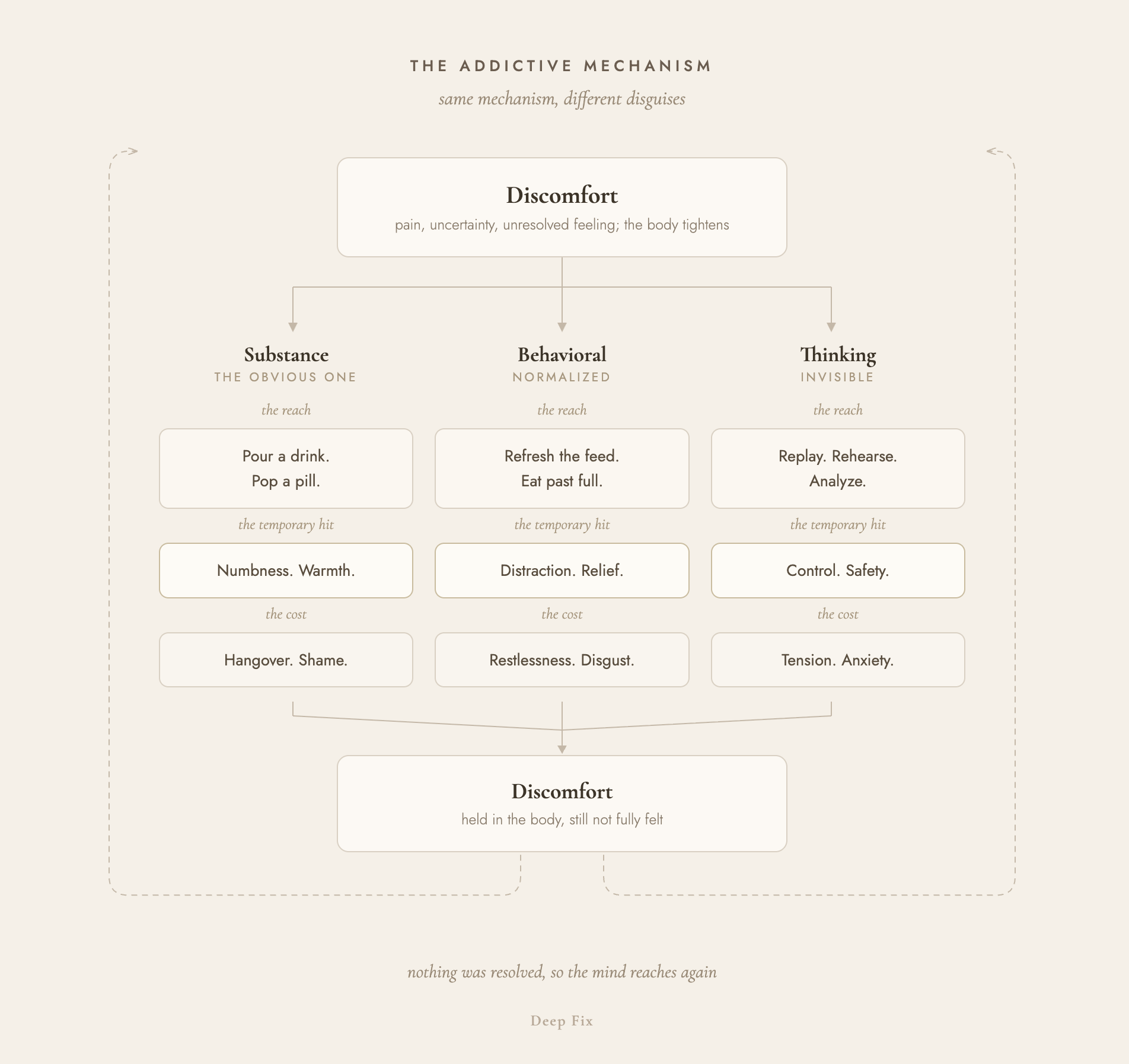
And like any addiction, there is a hit. You replay the conversation, and for a brief moment, there’s relief, the feeling that you’re on top of it. In control. But the relief never lasts. The body is still left with whatever sensations you were trying not to feel. The uncertainty returns as discomfort in the body, and the mind reaches again, this time for another thought, sure that one last round of analysis will settle it. And this all happens at the speed of thought, which is to say, instantly, before you realize it’s happened.
Over time, the field of experience narrows until the story narrated, on loop in your head, feels more real, more important, than the miracle of life unfolding directly in front of you.
It took me roughly a decade of enthusiastic self-destruction, followed by an unexpected brush with the Absolute, and then another decade of recovery, including working in the addiction space myself, to realize it’s addiction all the way down.
We change the object, but keep the mechanism.
The object shifts from opiates to Instagram to productivity, but the move is always the same: escape the feeling and reach for the next thing that promises relief. Thinking is just a higher-status version of this. It grants you the feeling of control.
The thing is, the nervous system cannot distinguish whether the object you’re reaching for is a substance or a thought. The underlying physiology remains the same: the body tightens. Next time you catch your thoughts racing, notice what your brow, jaw, shoulders, or belly are doing. Even if it’s subtle, some part of you is bracing.
But once that compulsion to think through everything relaxes, you find there’s something wiser and more effortlessly responsive that’s been running the show. A way of being in the world, amid all the trappings of modernity, that doesn’t revolve around constant internal commentary. And it doesn’t render you dull or passive. If anything, you move through life more spontaneously, more lovingly, more playfully, and, somewhat annoyingly, more effectively.
You trust yourself to respond to the text when it comes, rather than rehearsing it. You let the dumb thing you said six hours ago dissolve without a post-mortem. You walk into the work event without pre-adjusting anything and speak from the core of your being. At dinner, career domination thoughts might still come and go in the distant background, but you’re there, and the people you love can feel it. You start to see that much of what you’d been strategizing can, and does, happen all on its own.
This is, more or less, what every serious contemplative tradition has been describing for thousands of years.
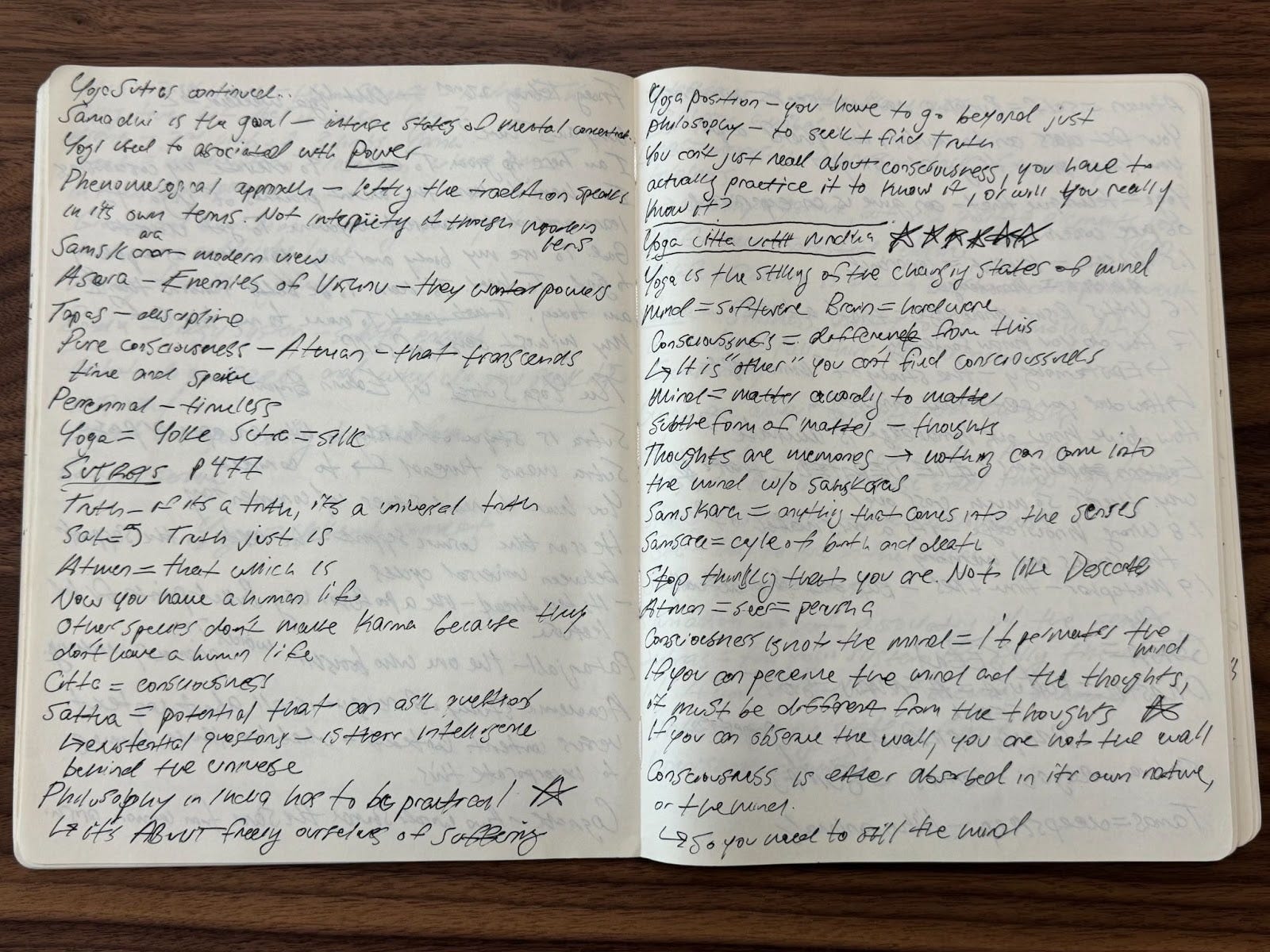
It just took me an embarrassingly long time to actually grok it. During my first hatha yoga teacher training, we did a sutra study with Edwin Bryant, who wrote the definitive Western commentary on the text. We spent an entire day on this one line:
Yoga citta vritti nirodha.
This is Sutra 1.2, the opening salvo of the entire tradition. It means: yoga is the stilling of the fluctuations of the mind. Everything else—the postures, breathwork, ethical precepts—is just preparation for releasing your grip on mental noise.
The tradition I’ve spent even more time in, Buddhism, basically says the same thing with more mechanical precision. The Pali word for clinging, upādāna, means fuel.2 We keep feeding the fire of thought with our grasping—at feeling good, not feeling bad, being right, and the story of who we think we are. Nirvana means to blow out the flames. The Taoists called it wu wei, effortless action. The Christian mystics spoke of releasement, letting God act through you rather than narrating your way through existence.
Across all cultures, sages have told us that you can set down your compulsive inner commentary and discover that something deeper has been living you all along.
Which raises the obvious question: how do you actually do that?
I took a first pass at this in a previous essay on the shift from left to right-hemisphere dominance. But the addiction frame I’m exploring here goes somewhere different, and I think closer to the root. That piece was about changing how you perceive. This one is about loosening the compulsion that keeps you locked in thought in the first place.
And it can be trained. The time and effort vary, but progress comes faster than you’d think. You can make noticeable headway in ten-minute bouts of practice. You can make serious progress if you commit to thirty-minute sessions and noticing the hook throughout your day. The catch is that the achievement orientation still running modern culture, including most of self-help and spirituality, is the very thing you have to relax here.
Once I understood that this was the mechanism I needed to work on, it took me about two years of devoted practice to reach a life-changing result: thought moved to the background and direct experience moved to the foreground.
Then, something I’d describe as an “auto-release” function became established—where overthinking definitely still happens, but lets go on its own, partly because the discomfort of the thinking loop has become so obvious. In short: it’s reliable access to being “in the zone,” which is a way more creative, fun, and enjoyable mode of existence.
All my prior spiritual practice and training helped, but if someone had pointed this out to me more clearly and earlier, I’m convinced I could have saved myself a great deal of time. Which is a big part of why I’m writing this today.
What follows is the simplest version of what I wish someone had told me.
You can’t think your way out
The most important thing to realize is that you cannot stop thinking. Trying to is counterproductive. The issue is not that thoughts arise, but that you believe they’re yours. A thought shows up, and because it showed up in your head, you assume it’s important, meant for you, and worth following. So you follow it. And by the time you notice, you’re already three thoughts deep.
And like all addictions, this happens compulsively, and it has consequences: you miss what’s more primary in experience, such as your body, the room, or the person right in front of you.
All addictions are intelligent, and the compulsion to think is no different. For many of us, staying in our heads was the safest place to be, especially early on. The nervous system learned that if you can think your way through something, you don’t have to feel it. Thinking became your protector. At the time, it was a smart strategy.
The temptation is to wage war on your own thinking. What helps instead is recognizing, with as much compassion as you can muster, that a part of you has been working overtime to keep you safe. And giving it permission to take a break.
This is also why pop-psychology advice on stopping overthinking often doesn’t work. You can’t override a nervous system response with a mental command. That’s a top-down instruction to a bottom-up problem. The body has to feel safe enough to stop gripping before the mind will let go.
So the first move is to relax the body.
Drop down
The practice begins below the neck. The body is the doorway to training your attention to rest on something, anything, that isn’t thought. Such as, the direct sensation of being alive. It’s especially helpful to let attention move down, down, and then even a little further down. Feel your feet on the ground. My favorite prompt here is to imagine that each sole of your foot has a pair of nostrils, and you are literally breathing from the earth.
A lot of spirituality and self-help talks about focusing attention on the heart, but for most Westerners, the heart is actually too close to the head to quiet mental distractions. Instead, the pelvic bowl is an endlessly rich place to rest attention, breathing the perineum into your chair and expanding that three-dimensional space like an accordion.
Sink downward, as effortlessly as a leaf falling from a tree. The lower you settle, the more the nervous system gets the signal that it’s safe to let go.
Come to your senses
The sense gates are your other doorway, because they are not thinking. When attention inhabits a sense, thinking naturally fades to the background. You can taste this freedom as easily as shifting your focus from reading these words to feeling the sensations in your right hand or noticing what you can hear right now.
Instead of thinking, you simply sense. Ideally with an explorer’s mindset, playing with the underrated joy of bouncing awareness between your faculties of perception. Feel the tips of your toes and heels against the ground; sense the whole body all at once; open into the sounds around you; notice the entirety of the visual field.
A great practice for this is Shinzen Young’s “See Hear Feel,” where you simply note what’s happening—whether you’re seeing, hearing, or feeling—and notice how effortlessly attention moves between them. You immerse yourself in each sense, as fully as possible, for just a few seconds at a time. Part of the revelation is how much is already going on that has nothing to do with thinking.
Thinking is the sixth sense
In Buddhist psychology, thinking is classified as exactly that: the sixth sense. The mind is a sense organ just like the ear or the eye, and thoughts are its objects, the same way sounds are objects of hearing. This frame is radical if you take it at its word. We have a hard time accepting that thinking is just like hearing or seeing. But for a moment, let’s pretend it is.
Can you stop sounds from arising? Can you stop the visual field from appearing? Can you, despite your best efforts, not taste chili when you spoon it in your mouth?
You can’t. And the same applies to thinking.
When thoughts become just another sense, something that just happens like the weather, your identification with them can soften. Loud construction outside your Zoom meeting is annoying, but you don’t believe it says anything about you. Meanwhile, a harsh thought shows up, and suddenly it’s you and all your failures. That is the addictive hook.
It feels like we control those thoughts when, in fact, we do not. And I have a quick way to test that.
Thoughts without a thinker
Get quiet for a moment. Close your eyes and pick a number between 1 and 50. As you do this, pay close attention to how the number appears. Did you think it before it arose? Or did it just appear, the number actually being a complete surprise to you?
The spoiler is that you never chose it. It just appeared. And the more unsettling reality is that this is how all thinking works. Even when it feels like you’re planning what you’re going to think, the thought has already been produced by causes and conditions outside of your awareness. That’s at least how the Buddhists explain it.
I know that even if this little exercise landed for you, the bigger claim—that this is how all thinking works—is harder to believe. And if you really let it in, it can be destabilizing. But if you keep looking, you can’t unsee it: there’s no author behind the thought stream. It’s worth going slow here, and being gentle with yourself, because it pokes at the foundations of identity itself.3
You already know how not to think, which is good news
Most daily actions happen without you thinking through them. Driving is one of the most obvious examples. Your foot adjusts the accelerator and brake as needed, your hands flip the blinkers, and you can swerve from the d-bag who cuts you off before a single thought gets involved.
The same goes for pouring orange juice, cracking eggs, taking a walk, or riding a bike. You even do it half-asleep every night, adjusting the pillow when you’re uncomfortable.4 The body knows how to take care of itself. Athletes train specifically so that thinking drops away and they can dynamically move and respond from somewhere beyond thought. Surfers are deeply in touch with this, attuning to the water and wind and swell until the self disappears and flow takes over.
Thinking can layer on top of these activities afterward and take credit. But the invitation here is to do one mundane task today, and do it with zero internal commentary. Notice that you still function. Notice that you might function better! And notice how fast the narration rushes back to claim ownership, which reveals the depth of the habit.
The key is noticing that you’re aware of doing the task without thinking about it. You practice this over and over, building confidence, gradually handling more complex situations. It’s unreasonably delightful. This is wu wei.
No thought, no problem
This really does go all the way down. The addiction to thinking is, at root, an addiction to wanting things to be different from how they are. The fuel is always some version of: this moment isn’t enough. The machinery of mind grabs a thought, hoping it will resolve the tension. Alas, it never does. So it grabs another, and another, and the body is left holding whatever you were trying not to feel.
But as you get better at relaxing the compulsion to think, a funny thing happens. Without the thought about the experience, there’s no problem.5 When you meet sadness, fear, or frustration without a storyline, they’re just sensations moving through the body. Sometimes it’s brutal. Grief can feel like your chest has been completely hollowed out. But because you’re not numbing out or retreating into your head, you’re feeling more of it, not less. You’re just not adding the story that makes it worse.
The unwinding, if you want to boil it all down, is pretty much one move: notice the loop, pause, feel what’s actually in the body, relax, open to what’s here.6 Or practice one of the above exercises. Repeat until it rewires. And eventually, if you stay with it, the whole practice intuitively collapses into something simpler than words—you just relax, lovingly, into what’s here.
What’s on the other side
When the compulsive loops quiet down, thinking actually gets better. Creative thoughts arise unbidden, with a freshness that the busy mind could have never produced. That’s because the mind was never the problem.
When I sit with coaching clients, free from overthinking, I’m spacious and open-hearted. Some-thing registers what they’re saying without me efforting to process it. Rather than planning my response, I listen from empty space, notice intuitive pings in the body, and wait to see what wants to come out. It takes time to build trust in this, especially when it comes to speaking. But when you do, it changes your relationships in ways I can’t oversell.
The ordinary moments is where it gets exceptionally good. Early in the morning, when Grace and my son are still sleeping, I unload the dishwasher. And it becomes an adventure… How quietly can the plates land? How does the body know to rotate the mug handle inward without being told? The whole organism conspires together to not wake anyone, and I’m kinda just along for the ride, almost stoned on the elegance of my own hands.
Or right now, writing this draft, typing on my keyboard, there’s awareness of everything in the room. From my window, I see sideways rain, a rare sight in the Oakland hills, pounding the sidewalk; the palm trees across the street look like they’re in a hurricane in Florida. My playlist sounds delicious in my ears. A ginger tea is steaming on my desk. And the words just come out, arising from nowhere, appearing on a screen that is just there in front of me. As I type, I’m not strategizing what will come out. But I can still notice when the thought this essay is getting too long shows up. Useful data!
This shift, from being thought-dependent to allowing the source of life to lead, is in the neighborhood of what contemplative traditions call spiritual awakening. I’ve avoided that term until now because I think this process is even more natural and accessible than that, a human birthright beyond any lineage or vocabulary.
But it turns out “awakening” is largely about waking up from being lost in compulsive thought.7 And the depth of it is determined by how thoroughly you’ve stopped trusting thought as your source of reality, and how much you trust the larger field of experience instead. When thinking relaxes its grip, so does the identity built on top of it. And what comes through, in my experience, tends to be intuitive and tremendously kinder than anything I could have thought my way to.
Carl Jung once described addicts as frustrated mystics. I believe that’s true for all of us. We’re all chasing, with increasingly sophisticated tools, relief from the chase itself. At the root of every addiction is a longing for what’s on the other side of thinking. And recovery, all the way down, is a homecoming to this place beyond words.
Thanks for reading. Essays like this take me ~30 hours of work and, apparently, a lifetime of practice. If you got something from it, consider becoming a paid subscriber. It’s the best way to directly support my work.
Or, if you want to contribute in a smaller way, a like or share helps a guy who does what I do.
Overthinking workshop: If you want to practice any of this, I’m hosting another online workshop with my friends at Aurora on May 22nd. Discover you can move, act, speak, and relate without thinking your way through it. Register here.
Work with me: I combine executive coaching with somatic therapy to help leaders heal this pattern at the root and do their best work. Learn more here.
And special thanks to John, Erin, Sam, and Grace for help with this one.
Reciprocal narrowing is a term coined by neuroscientist Marc Lewis and popularized by cognitive scientist John Vervaeke. As you repeatedly chase relief, your mind narrows around what delivers it. The fewer options you see, the less flexible your mind becomes, which narrows further, until both your outlook and your agency have collapsed around nothing but the next hit. In this essay, I’m making the case that the same mechanism operates with thinking itself, only more subtly. I wrote about reciprocal narrowing more extensively here.
For my dharmanaut readers: the fuller sequence is taṇhā (craving/thirst), which conditions upādāna (clinging/fuel), which feeds papañca (mental proliferation)—the compulsive storytelling loop this essay is really about. Taṇhā lights the fire, upādāna keeps it burning; and you can stop feeding it.
Please note that this type of exploration can be intense. Deep inquiry into the nature of identity is best done with the support of a skilled therapist or experienced teacher.
One of my teachers, Jason Bartlett, calls this natural dharma: the intelligence that knows how to adjust your position when you’re half asleep is the same intuitive capacity you’re learning to trust to handle all of life.
By no means does this intend to suggest that your problems magically disappear. It means they massively reduce in intensity and scope, because you’re no longer compounding them with narrative.
If you want to go deeper with this: notice that the noticing itself happens on its own. The mind moves from distracted to undistracted without your help. And the more you notice, the more noticing happens. Some teachers instruct you to never effort to change anything at all, because the moment you recognize distraction, that recognition is itself the awareness you are looking for.
This framing is indebted to Dzogchen teacher James Low.
As someone who’s lived in her head her entire life, this essay is incredibly helpful. I will be digesting it for quite a while. Deeply grateful to you.
*scratches arm*
hey bro got any spare thoughts I can bum off you
seriously though, well done. interesting perspective.