
Train your attention, or something else will
A practice for reclaiming attentional agency, perhaps your most underrated freedom


If you’ve been blessedly offline, you might have missed that “agency” is the obsession of the hour. Agency, in this context, is something like the opposite of helplessness.
It is the fixation of tech founders, productivity guys, rationalists, and my own spiritually-centric Substack milieu, where the dream is to become an “agentic sage,” the meeting point of high worldly impact and high consciousness. The New York Times has weighed in. Cate Hall and Sasha Chapin have a book on it out in a couple of weeks, which I’ve pre-ordered and suggest you do too, given the consistent profundity of both their insights.
It’s not hard to see why the word caught on. Culturally, we are coming out of an era focused on the forces that shape us: systems, power, trauma, attachment styles, algorithms, screens, dopamine… take your pick. Much of this was long overdue; rugged individualism had quite a run.
But the corrective pendulum overshot. Somewhere along the way, we went from illuminating our constraints to being defined by them, so fluent in our own conditioning that we can describe our wounds better than we can act inside them.
To further complicate things, or perhaps drive them, we are building machines that can increasingly operate on our behalf. AI “agents” are now pitched as the future of work, taking on more of the tasks that once required human discernment. Agency, in other words, is becoming the central human question of our age: when almost anything can be outsourced, what is ours to do?
To be clear, being able to make what you want happen in the world is a good thing. I say that as someone who once lost much of his functioning to addiction and had to relearn the basics of adult life. So I don’t take agency lightly.
But every kind of agency rests on a single skill you were likely never taught.
To act on the world, you first have to hold an intention over time, through temptation and difficulty, until it becomes something done. Attention is what makes that possible. Without it, even great talent goes unused, and your best intentions remain just ideas.
Before agency becomes a personality type, moral achievement, political argument, spiritual ideal, or a feature we install in machines, there is a prior question:
Can you put your attention where you want it, and keep it there?
I didn’t have a term for this until one of my retreats last year, when I was fumbling to describe the root move behind almost everything I care about: meditation, recovery, somatic psychotherapy, making things, prayer, awakening, even love.
Someone across the circle said, “You mean, like, attentional agency?”
Yes. Exactly. That.
Attentional agency is the most basic freedom you have. It’s what your life is built on.
It’s the only agency you are always in possession of. You can’t reliably control what happens to you. You can’t control the thoughts you think or the emotions you feel—if you could, you’d have stopped worrying long ago, and put blogs like mine out of business. Despite what it seems like from the inside, you aren’t the author of your thoughts. They arrive on their own, like weather patterns.
But you do have a sliver of freedom in where your attention rests, and how tightly you hold it. And thin as it may feel at times, it’s enough, because in the end a life is made of whatever you paid attention to. That sliver is the miracle of individuality, and learning to work that one small margin is, I’ve come to believe, the core project of a conscious existence.
Attention is the most valuable resource you have, and the most hunted.
A surprising amount of a life gets decided in a few seconds of attention. Someone catches your attention at a party, and whether you follow the thread or miss it—because you’re scanning the room or stuck in your head—can determine who’s asleep beside you thirty years from now. Look away from a toddler for the half-second it takes him to reach the street, and the glance that catches him in time might be the most consequential thing you ever do.
You don’t get moments like these back. Whether you’re there for them or not comes down to attention, and attention, unlike luck, can be trained.1
Let’s start with the version of yourself that has almost no attentional agency. Your days pass by in a blur. You wake up telling yourself you’ll finally do the thing, whether it’s a project or a workout or an email, and surface by the afternoon not knowing where the time went. At dinner you’re lost in thoughts about how you’ll never change and fuck, I guess this is just how life is now, as you sit across from your family.
Nothing catastrophic happens, which is kind of the problem. You’ve gotten used to your own intentions dissolving by mid-morning. All your days feel thin.
Now give that same person a little training. The mind still gets pulled into thoughts and distractions, but you notice sooner and come back faster, to presence or to whatever you were just doing. Your days feel more substantial, like you actually lived them. The days feel longer too, in a good way. Your groggy morning intentions convert into actions more easily, and you start gaining the capacity to sustain those actions for longer and longer. This feels amazing. Most of us just want to be able to create.
Best of all, your sustained actions mean you get to accomplish your dreams, which may sound like a New Age infomercial until I remind you that every dream is just several thousand hours of devoted attention.
But none of this can happen if you let yourself be hunted.
You already know what it feels like to be hunted: you open your phone to look one thing up, and twenty minutes later you surface from a YouTube rabbit hole with no memory of choosing any of it. In my case it’s usually a survival dude building an igloo shelter in an Alaskan storm, an MMA knockout reel, or some obscure dharma talk. Unfortunately, the Don Drapers of Madison Avenue were hiring psychologists to engineer this long before Silicon Valley did it for your favorite apps, and we’ve now basically turned it into the business model of our time.
You’ve undoubtedly heard the term attention economy, and how modern life is built to hijack your attention.
And then the even newer trend: a second economy to sell you the cure. Apps that lock you out of your other apps, flip-phones with the internet stripped out, plastic bricks you tap to disable your own device, screen-time dashboards that show you exactly how many hours of your day you lost to scrolling…
We’ve lost our attentional agency, and we’d rather pay for the quick fix than rebuild it.
Algorithms have been training your attention for years, just not in your favor. Fortunately, the human brain is awesomely plastic at any age. The same plasticity they exploit is yours to reclaim.
What follows is the how. It starts with a few core skills and some defense against screens, but it goes deeper than the apps, because the mind was the original doomscroller. As you stay with it, you’ll expend less energy “fighting” distraction, though that’s kinda just the appetizer. In time the practice matures into the agency to rest attention on what you love, and to cultivate a reliable sense of okayness that doesn’t depend on external circumstances.
The practice of rebuilding attentional agency
If attentional agency is putting attention where you want it and keeping it there—so you can create the life you intend—then there are three core skills to train.
This practice is the through-line of much of what I’ve written lately, from freedom from overthinking to waking up the right hemisphere of your brain to choosing the direction your life goes.
Below is the simplest version.
Notice when attention is lost, whether it wandered off or was captured.2 You can’t choose where attention goes if you don’t know where it is. Early on, this noticing comes minutes, or even hours, after it’s drifted. So celebrate every catch, because rewarded behavior repeats: the more you celebrate, the sooner you notice, until the gap shrinks to seconds.
Rest attention where you choose. And note the word: resting, rather than placing or aiming. Rest gestures at the intended mode of this practice, which is relaxed, unforced, curious, playful. Attention that gets forced is not sustainable, as anyone who has tried to white-knuckle their way through a boring work meeting knows.
Return it. Attention will wander off again, because that’s its nature, so the wandering is not a failure of the practice. Bring it back lovingly, as many times as it takes. The nervous system learns the way muscles do, and each return is one more rep. It’s better to think of “keeping attention on its resting place” as returning it there over and over, rather than holding it still.
The three skills above remain throughout. What changes as you practice is what you attend to, which gets subtler as you go, from the pull of the phone in your pocket all the way down to attention itself. We’ll work our way down from here.
But before we do: if this sounds suspiciously like meditation, you’re not wrong. In Patanjali’s Yoga Sutras, the foundational text of yoga, this skill is called dhāraṇā: binding attention to one place. In the Bhagavad Gita, when Arjuna complains that the mind is as hard to control as the wind, Krishna answers that it yields to abhyāsa, which is the practice of returning again and again.3
Even the Buddhist word we typically translate as mindfulness, sati, literally means remembering: remembering to come back. And in 1890, William James, the OG of American psychology, wrote in The Principles of Psychology:
“The faculty of voluntarily bringing back a wandering attention, over and over again, is the very root of judgment, character, and will.”
Humanity has known all this for a very long time. We just happen to be facing attention’s greatest adversary yet.
Watch where your attention goes
The way down starts with the least subtle of attention’s captors: screens and media. Before you can turn inward, you have to play some defense against them, or modernity will happily decide where your attention goes.
This point is much belabored, and I’ve written about it often, from negative media as a drug to the importance of tracking phone pickups, so I won’t repeat myself here.
We begin playing defense with observation. Spend one full day tracking where your attention actually goes, without managing or wrangling it, the way a field biologist watches an animal. What you’ll find will likely align with the research: attention rarely rests in the present moment, and, as the landmark Harvard study dubbed it, “a wandering mind is an unhappy mind.”
If you’d shown me a pie chart of my attention from my old life, the biggest slice would have been labeled “managing how I’m seen,” a respectable name for self-attack.
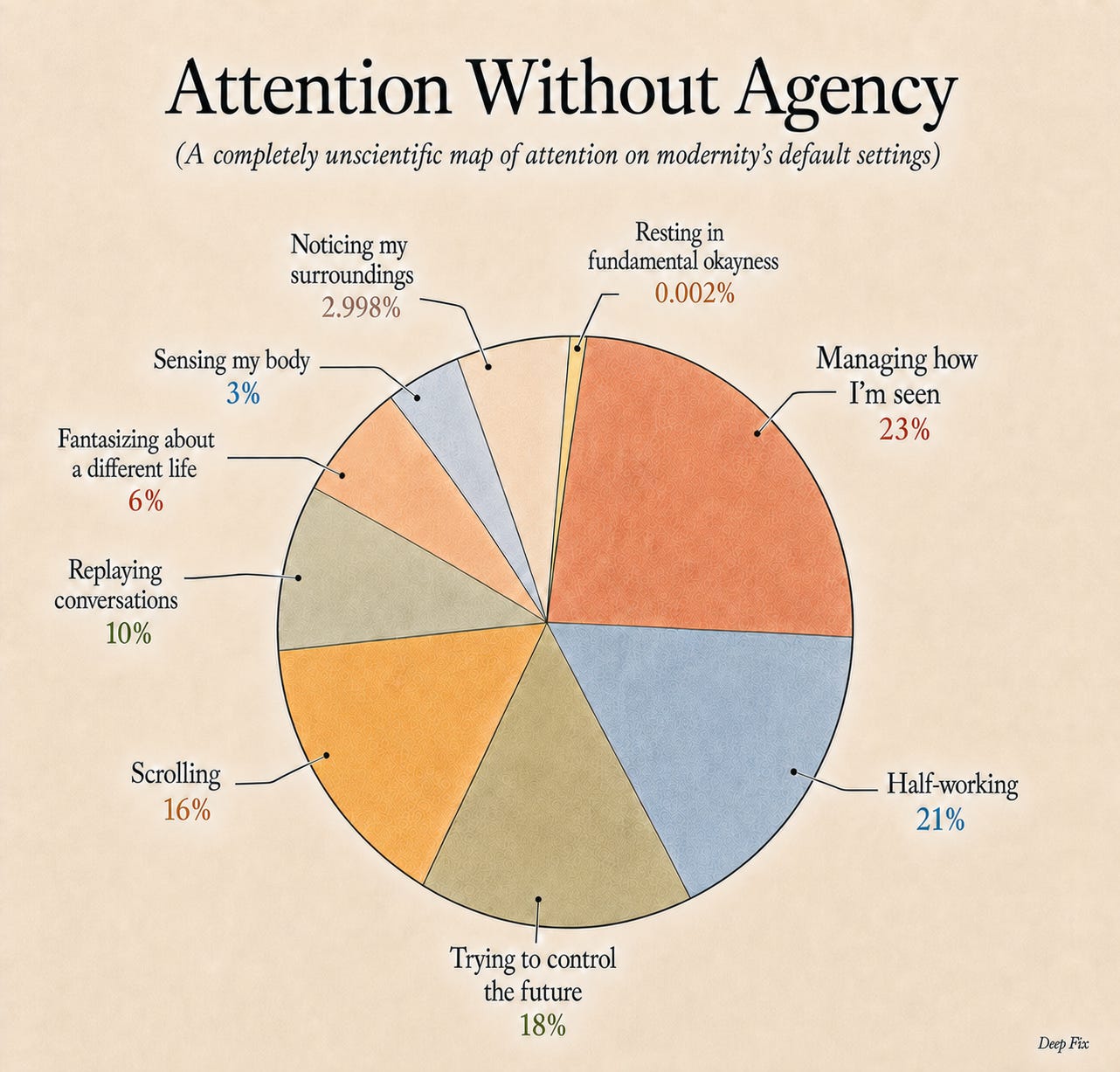
When you see how often your attention goes somewhere dark, you’ll be tempted to declare war on your own mind. Don’t do this! The war on distraction is itself a distraction. So no fighting yourself. Just notice when attention strays, and gently bring it back.
If you have ADHD, or attention that feels extremely difficult to work with, you can still train this—so please don’t be discouraged. The science of contemplative training for ADHD is still young, but the results are promising, especially when paired with emotional work. And the support out there keeps evolving. Rather than quick fixes, the best of it improves your attentional agency, including my friend’s company Attention Copilot, whose live trainers work alongside you in real time as you work through emotional blocks that arise.4
Oh, and don’t expect the wandering to ever fully stop. A meditation-teacher friend of mine loves to ask the enlightened masters he meets about this, and every single one, he tells me, still gets distracted. I know plenty of accomplished meditators myself, and I kid you not, many are glued to their phones as much as anyone.
This should comfort you and also tell you something important: deep spiritual realization will certainly help with mind-wandering, but it doesn’t guarantee attentional agency in the way I mean.
Rest attention on what you love
The first resting place is the life in front of you. We all know what it feels like to sit across from someone whose attention is divided. Every parent acutely knows the difference between actually being present with your child and being next to them while scrolling your phone, half-listening to a podcast, thinking about work, or doing anything else. Your child can feel it too. That difference, between being looked at and being truly seen, comes down to the quality of attention.
Attention is the unit of love. Whatever has your attention quite literally has your love, whether you mean to give it or not.
(Which is what makes the pie chart from the last section so sobering. It is a map of what I—and maybe you—have been loving.)
So rest it on what’s here. The way in is usually through the senses, whether it’s the warm water on your hands, the sound of the room, or the taste of what you’re eating. The senses only ever happen now.
Then, within what’s here, favor what you love. Attention is an amplifier. If you’re walking with a blister forming on your toe and birdsong overhead, whichever one you attend to becomes the vibe of your morning.
When a raft flips in whitewater, the guide only points toward safety, never at the rocks. A swimmer flooded with cold water and adrenaline cannot process “not that way.” The system only registers a direction, and what you point at, you get more of. This is called point positive, and it applies to whatever you’re trying to build or become. Train your attention as the guide would, gently pointing it toward what’s presently beautiful, loved, or simply safe.
This practice works by accumulation. Each return of attention takes a second and might feel unremarkable, but your default is changing over time. You are training yourself, little by little, to eventually become present without trying. And that’s when ordinary moments become decidedly psychedelic.
Rest attention in fundamental okayness
Underneath the life in front of you, there’s a subtler place to rest your attention, though your brain might resist it. We descend from creatures who survived by assuming every rustle in the grass was a predator, so the brain learned to take in bad news instantly and deeply, while good news barely registers at all.
This is negativity bias, which our media and culture only reinforce. The brain, as the neuropsychologist Rick Hanson describes it, is like Velcro for negative experiences and Teflon for positive ones. A threat sticks the moment it touches you. An ordinary pleasure slides off within seconds, unless you deliberately hold it.
But! Even though the brain is wired for survival, we are, at our essence, good. Better than good, actually. Tibetan Buddhism calls this basic goodness, the teaching that beneath all the threat detection, our fundamental nature remains untouched.
Countering the negativity bias and rewiring the system toward that goodness is the deeper half of attentional agency.
So, when something is even mildly good, hold it. Whether the warmth of your morning coffee, clean sheets, your kid squealing as he rides his scooter, or the surge in your chest when your team scores, rest attention there for a breath or three and let it register.
Ask yourself, as I’ve suggested before: am I okay, deep down? If there’s even a pixel of a yes, savor it. Returning attention to that basic okayness, over and over, retrains the whole system toward safety, until the okayness is no longer something you have to look for. It becomes the substrate of your life.5
The source of attention itself
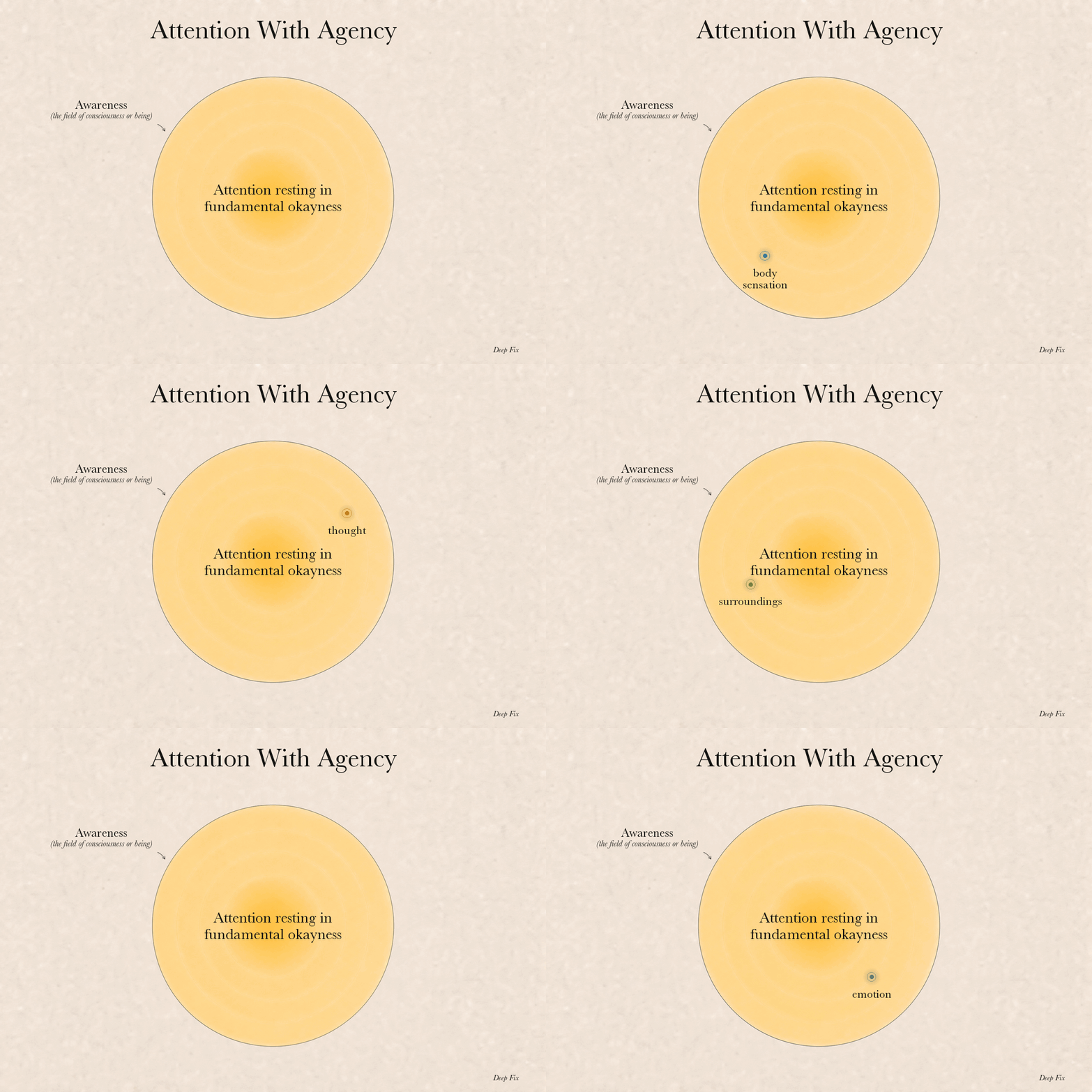
Training attentional agency starts with objects, which give your attention something to hold. But as we’ve progressed, the resting places have been getting subtler. Even though you can direct attention at it, the okayness of the last section is not, technically speaking, an object. It’s more of a meta-somatic felt sense, something closer to awareness, consciousness, or being.6
And attention itself is not an object either. You can’t look at it the way you look at a thought, because it is the looking. So the final stage of the practice evolves into a natural inquiry: what is the source of attention?
Don’t answer with a thought. Look. Feel. Sense.
Or relax the focus altogether: let attention go wide open, wider than any object, and notice what’s left holding the entirety of your experience.
Either way, you won’t find anyone. Look for the source and there’s just attention, still moving to your to-do list, your thoughts, a sound, more thoughts, back again, with no one behind the spotlight running the show. Go wide and there’s no one at the center of the openness either.
One of the unsettling dharmic realities is that the “agent” of attention is a story added after the fact. I used to roll my eyes at a certain kind of New Age teacher waxing about the light of consciousness. But the more I live, the more I become a caricature of myself, turning into all the things I used to mock, so please trust me when I tell you that attention is, indeed, something akin to light. Rest attention in its own source and it becomes the space everything appears in, including you.
Which brings us to a fourth capacity, one I haven’t mentioned until now:
Letting go.
I didn’t want to muddy the waters with this earlier because it isn’t something you do, but stop doing. It’s also most effective once you’ve trained some stability of attention, which is why most meditative paths teach concentration before letting go. So don’t necessarily skip ahead.
Remember how you can’t control the moment of noticing, how the mind moves from lost to found all on its own? That goes all the way down. The same is true of resting and returning, even of the choice to point attention toward what you love and want to create. It all happens by itself, the way you breathe in your sleep. So eventually, you stop trying to do what is already happening. You simply let go.
Simone Weil famously wrote that attention, taken to its highest degree, is the same thing as prayer. Her word for attention was attente: waiting. Meaning, not straining toward anything, definitely not seeking anything, but suspending thought, leaving the mind open and the spirit ready to receive. Attention this pure is self-emptying; the “I” vacates the premises in surrender to something bigger. In other words, attentional agency taken to its height becomes a devotional offering, with no one doing the offering.
Despite many years of practice, my attention still creeps toward work (this essay included), even when my partner and son are right in front of me. The grooves of conditioning run deep. But when I stop trying to manage my attention and let go, it finds its way back to them. This is the edge of attentional agency for me: trusting my attention to return to what I cherish most instead of forcing it back. That trust is my moment-to-moment prayer. As I’m continually reminded, the universe is a better agent than I am.
I gave this essay perhaps too many hours of devoted attention. If you got something from it, consider becoming a paid subscriber. It’s the best way to directly support my work.
Or, if you want to contribute in a smaller way, a like or share helps a dude who does what I do.
What’s next: I’m building a four-week course on breaking your addiction to overthinking and rebuilding attentional agency, coming this fall. If you want first access, reply to this email.
Work with me: I help leaders rebuild attentional agency, do their best work, and live from fundamental okayness. Learn more here.
And special thanks to Erin, John, Sam, Pranab, and Jason for reading drafts and making this better. And to Boris, whose teachings greatly inspired the back half.
Actually, luck might be trainable. The psychologist Richard Wiseman studied self-described lucky and unlucky people for a decade. In one experiment, he asked both groups to count the photographs in a newspaper. On the second page, a half-page message read “Stop counting. There are 43 photographs in this newspaper.” The lucky people usually noticed it. The unlucky people, absorbed in counting, usually did not. Wiseman concluded that lucky people simply notice more, especially chance opportunities that others miss.
“Attentional capture” is the term cognitive psychologists use for the involuntary reflex that turns you toward a sudden sound, movement, flash, or buzz. Most digital media is engineered to exploit this reflex. “Mind-wandering” is what happens when nothing in particular demands your attention. The brain’s default mode network begins producing its own content, and attention drifts inward in rumination.
For my dharmanaut readers: In both the Gita and the Yoga Sutras, abhyāsa is typically paired with vairāgya, which means dispassion, or letting go. Meaning that the mind is mastered by practice plus release. My approach weaves the letting go into the unforced mode of the practice and into the fourth capacity at the end.
This doesn’t just apply to ADHD. If you chronically procrastinate on your most important work, or want to find more flow in your days, working alongside a savvy trainer is a great idea.
Much of my approach in the fundamental okayness section comes from my ongoing training with Boris and the Deepening Protocol, which I can’t recommend enough for anyone who’s into this sort of thing.
Common meditations often blur what, for this essay, is an important distinction. You’ll hear teachers say “move your awareness to the breath.” But awareness does not move. What moves is attention, the spotlighting capacity this piece has been training. Awareness is the field the beam sweeps through, the knowing that’s already there before you attend to anything at all. Neither one is an object you can inspect the way you can a thought. Attention is the looking itself, and awareness is the knowing it happens in. Bear in mind that spotlights and fields are imperfect metaphors, as everything is in this territory.
I find that attention is more easily directed when it is combined with appreciation. I see this appreciation as having two aspects; seeing the value in something and allowing it to affect my perception. It starts with something as simple as the breath. I become curious about these sensations so my attention can easily stay with them, and then the breath starts to calm my perception. I'm walking outside and I become interested in a tree, I notice how the details are irresolvable, and my perception is altered by this.
Thank you 🙏
Your post inspire !